
C-03 / Capability · Sialkot, Pakistan
Custom screen printing, DTG and sublimation for apparel brands
Screen, DTG, puff, high-density and heat-transfer printing with durability testing on the actual production fabric.
Custom Printing at a glance
- Methods
- Screen, DTG, puff, HD, transfer, sublimation
- Artwork
- Vector preferred; 300dpi raster for DTG
- Max area
- 38 × 45 cm (15 × 17.7 in) standard platen
- Testing
- Wash durability check per artwork
How custom printing works at LOMERAQ
Print method is chosen per artwork and fabric, not per price list. Flat spot colours run on screen; photographic gradients on DTG; dimensional logos as puff or high-density. Printing runs at vetted partner units; every new artwork is proofed on the actual production fabric and wash-tested by us before bulk approval.
Placement is documented on the spec sheet with measured offsets from seam reference points so repeat orders print identically.
How a print order runs
Printing is part of the garment order, not a separate job you manage. We handle the coordination between the sewing floor in Sialkot and the vetted partner print units, and keep proofing and approval in-house.
On the printed sample you approve the colour match against your Pantone references, print size and placement, the hand feel of the ink, and the result after the wash test. Once approved, the artwork file, ink colours and placement offsets are stored with the style spec so a repeat order prints the same way.
- You send artwork, placement and the garment spec with your RFQ.
- We confirm the print method per artwork and fabric and flag anything that will not reproduce well.
- The artwork is proofed on the actual production fabric and wash-tested by us.
- You approve the printed sample; placement is recorded on the spec sheet with measured offsets from seam reference points.
- Bulk is printed and checked against the approved sample at final inspection.
Choosing between screen, DTG, sublimation and transfer
As a general rule, screen printing pushes ink through one screen per colour, so it suits flat spot colours and bold graphics, and the setup is the same whether you print 25 pieces or many more. DTG prints the full image directly onto the garment, which suits photographic artwork and gradients, mostly on cotton-rich fabric. Puff and high-density inks build a raised surface for logos that should stand off the fabric.
Sublimation turns dye into a gas that bonds with polyester fibres, so it needs light-coloured, polyester-rich fabric and can cover the whole garment, which is why it is used on team kits, karting suits and balaclavas. Heat transfer suits small details, names and numbers, and technical shells where screen ink does not sit well. We recommend a method per artwork; the final choice is confirmed in the quote.
Artwork and files to send
Vector files (AI, EPS, PDF or SVG) are preferred for screen, puff and high-density printing. For DTG, send raster artwork at 300 dpi at the final print size. Include Pantone references for spot colours, the finished print size in centimetres and a placement mock-up showing where each print sits. The standard platen takes prints up to 38 × 45 cm (15 × 17.7 in); larger or all-over designs are handled by sublimation where the fabric allows.
If artwork is not print-ready, such as a low-resolution logo, text that is not outlined or colours that are not specified, we tell you what to fix before proofing rather than guessing.
Which product families it suits
Screen, DTG and puff printing are the usual choices for T-shirts, tank tops, hoodies and shorts. Windbreakers and tracksuits typically take screen print or heat transfer. Sublimation is used most on team kits such as soccer, basketball and cycling jerseys, and on karting gear, balaclavas and textile gloves. Leather garments are usually branded by embossing rather than printing; textile panels on motorbike suits and riding jackets can carry screen or reflective print.
Manufacturing examples
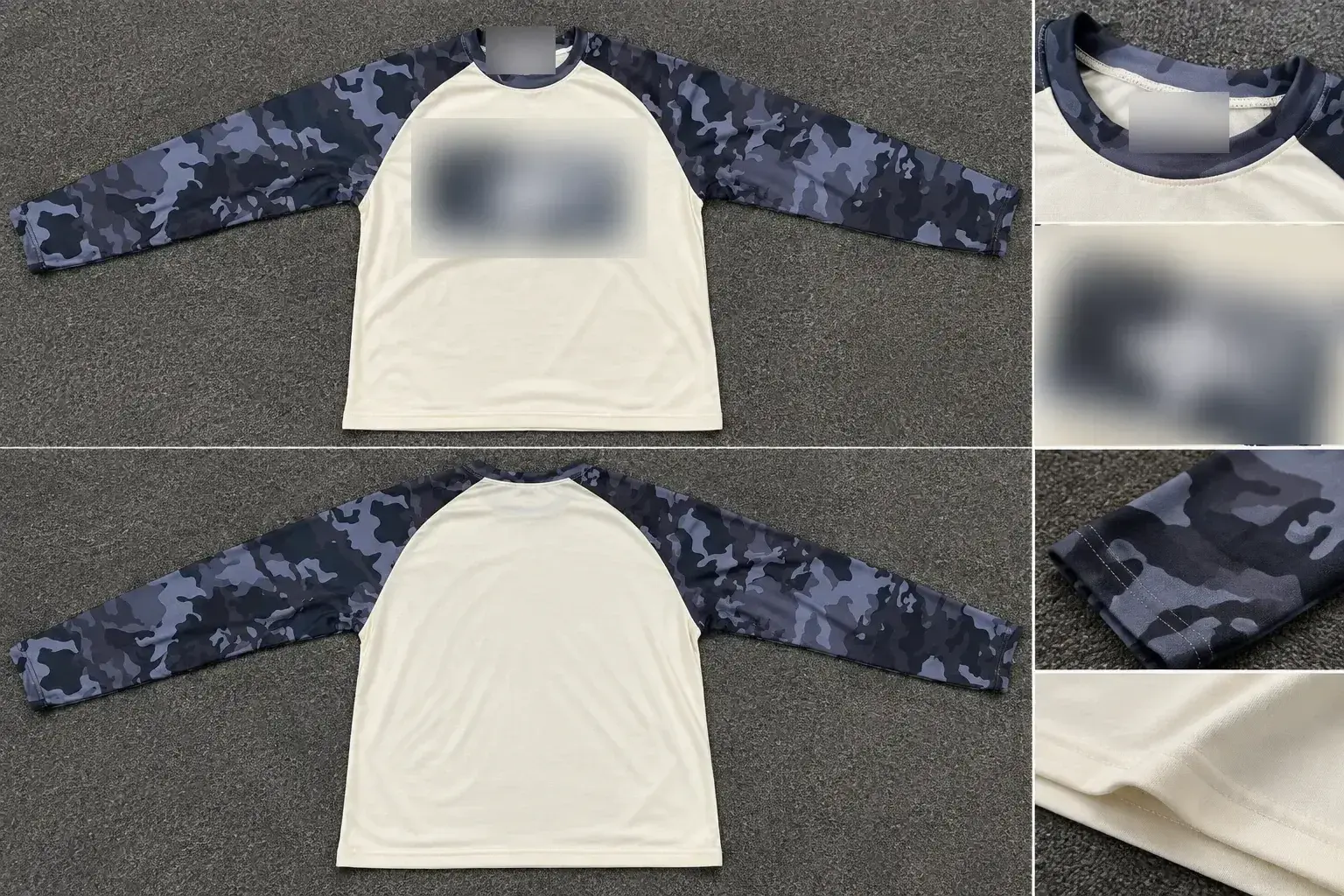
Custom printed raglan T-shirt
Raglan long-sleeve tee with contrast camo sleeves and self-fabric neck rib, and a multi-element front graphic print.
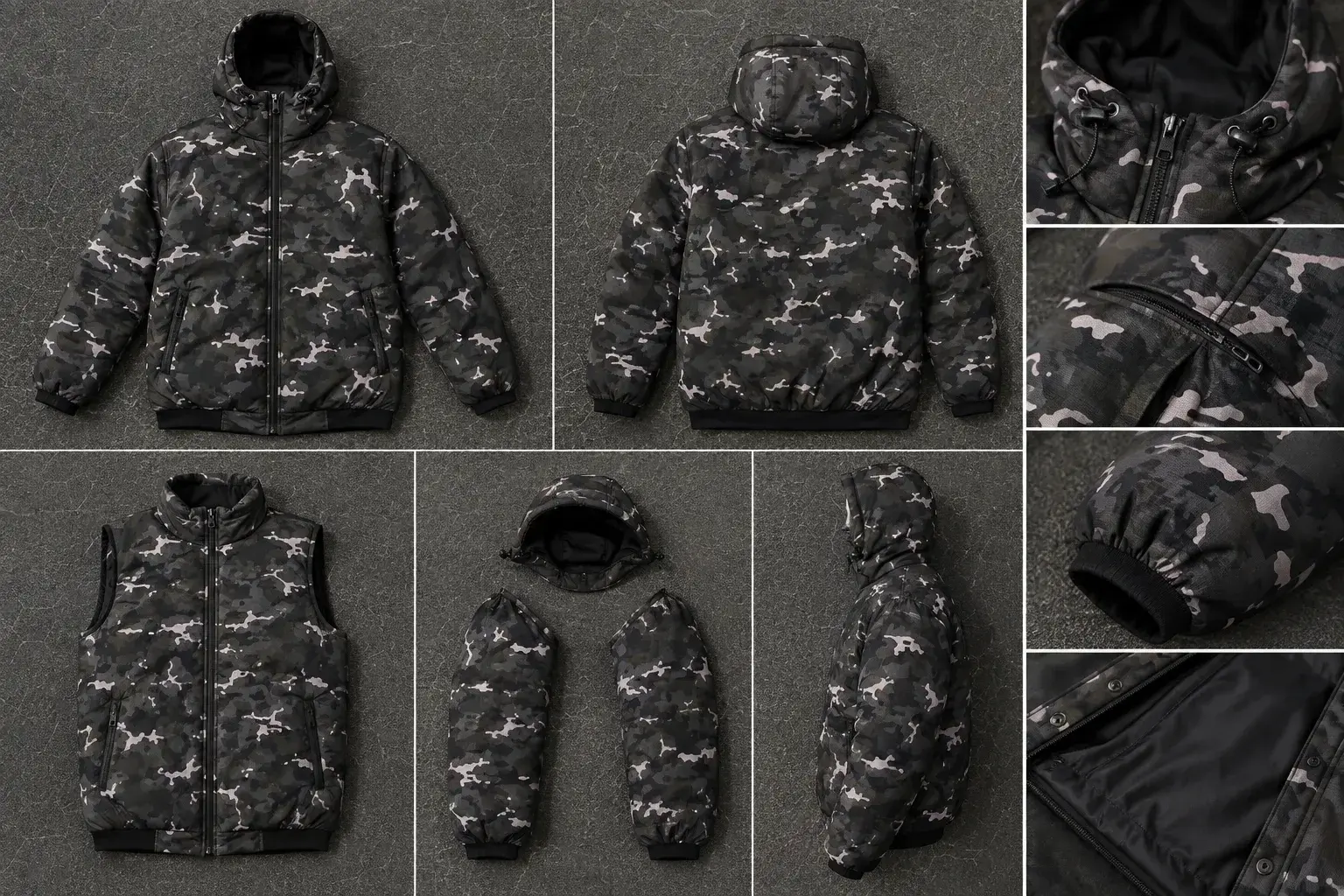
Convertible camo puffer jacket
Insulated puffer jacket with allover camouflage print that converts to a vest: zip-off sleeves, detachable hood, snap storm placket, rib hem and cuffs.
Frequently asked questions
Which print method should I choose?
Start from the artwork and the fabric. Flat colours and bold logos usually go on screen, photographic images on DTG, raised logos on puff or high-density, and full-garment designs on polyester by sublimation. Send your artwork with the RFQ and we recommend a method per design.
What file format do you need for printing?
Vector files (AI, EPS, PDF or SVG) for screen, puff and high-density work, and 300 dpi raster files at final print size for DTG. Add Pantone references, the print size in centimetres and a placement mock-up.
Is there a minimum quantity for printed garments?
The minimum is 25 units per order, split across sizes. Screen printing needs a screen per colour, so setup is quoted per artwork; the quote shows how the method you choose affects the order.
How do you check that the print lasts?
Every new artwork is proofed on the actual production fabric and wash-tested by us before you approve bulk. Bulk is then checked against the approved printed sample at final inspection.
Request a printed apparel quote